The Things I Long For, the Things I Hate. 

Dust. Fine, powdery dust that floats in the air like baking flour. It coats everything in a fine layer of misery, from the trucks we drive to the bolt carrier group of the rifle I carry. It permeates everything that I own, clogs my nostrils, scratches my eyes, and taints my food. It envelops me like a warm blanket, bringing a strange degree of comfort and insulation from the death that is everywhere.

The smell of diesel fuel, hydraulic fluid, and av-gas. It’s the smell of American power. We brought a staggering amount of mechanized machinery with us to this land, and it all runs on petroleum based products. Diesel spills from every truck, and hydraulic fluid leaks like rain from the overhead lines of the helos. The fuel farms are the lifeblood of the campaign, and they always seem to be upwind.

Nighttime. It’s when we live. Operations mostly run at night, because we own it with our advanced night vision optics. The heat is a little more tolerable, and we’re lesser targets for Haji. The sleep deprivation imparts a slight touch of delirium and a surreal texture to the experience, but that’s part of what makes it irreplaceable. Nighttime means brutal exhaustion, but also reward for the effort.

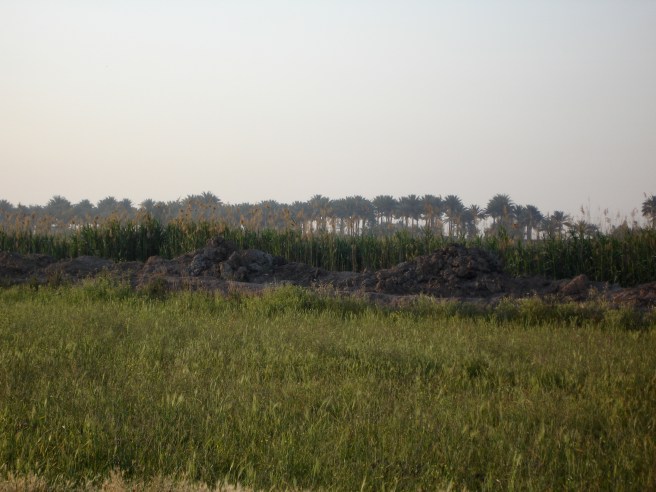
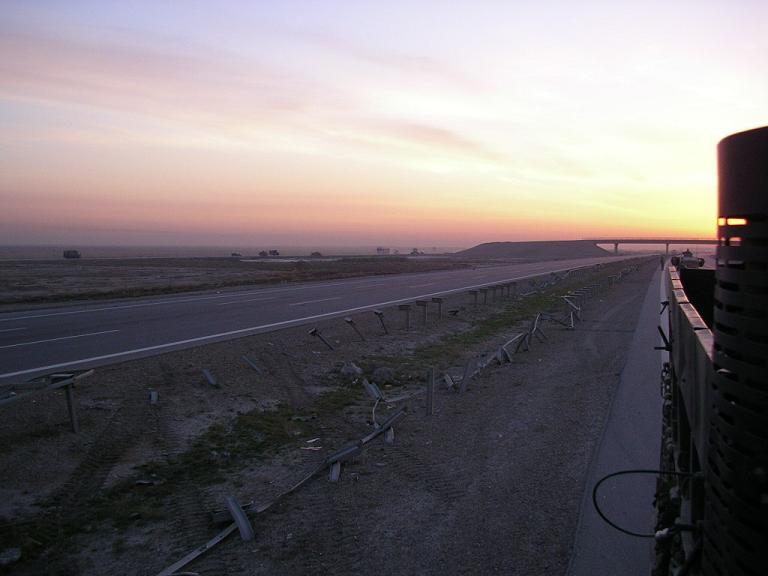
Skylines. Sunrise or sunset in the Middle East is something to behold. To climb atop the bunker and watch it happen is an experience so big I can’t comprehend it. Looking out across the desert in the blistering heat of midday. The cradle of civilization, a truly ancient land. The Tigris and the Euphtates rivers. Babylon. For crying out loud, this is the land they’re talking about in THE BIBLE! A kid from Georgia just can’t top that for sheer magnitude.

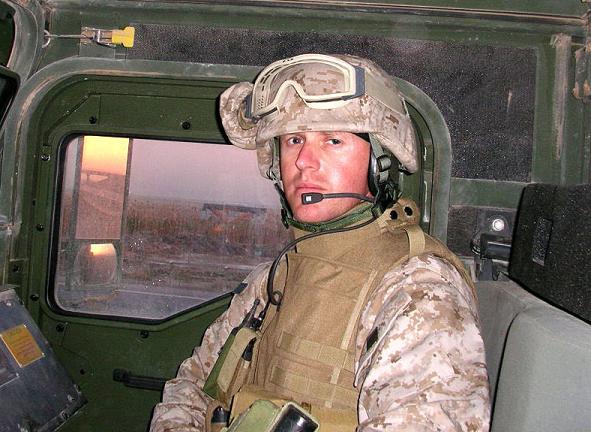
Youth. The young Marines I serve with are a new generation. Being a re-tread Marine, I’m 15 years older than my ranking peer group. These guys were just learning to walk when I took the oath. We can’t relate to each other on much of anything, other than the mission. They piss me off with their casual attitudes and belligerence, but in rare moments when they don’t realize I’m watching, I love the hardness of their spirit. Belligerent little assholes. They’re different, but we’re all Marines.

Purpose. My purpose is to serve. To serve, I have a mission. My mission is the business of caring for dead Marines. Young or old, enlisted or commissioned, all dead nonetheless. My mission sucks, but it provides a purpose that is tangible. All one has to do to see the direct result is turn on the evening news. Invariably, somewhere in there is coverage of another military funeral. If that Marine, Sailor, or Soldier was killed in Anbar province, my unit was the first to drape his body with the colors of his country.

I went to Iraq longing for a purpose, and I’ve grown to hate that. I should have been more careful about what I wished for.

To Get Them Home Again

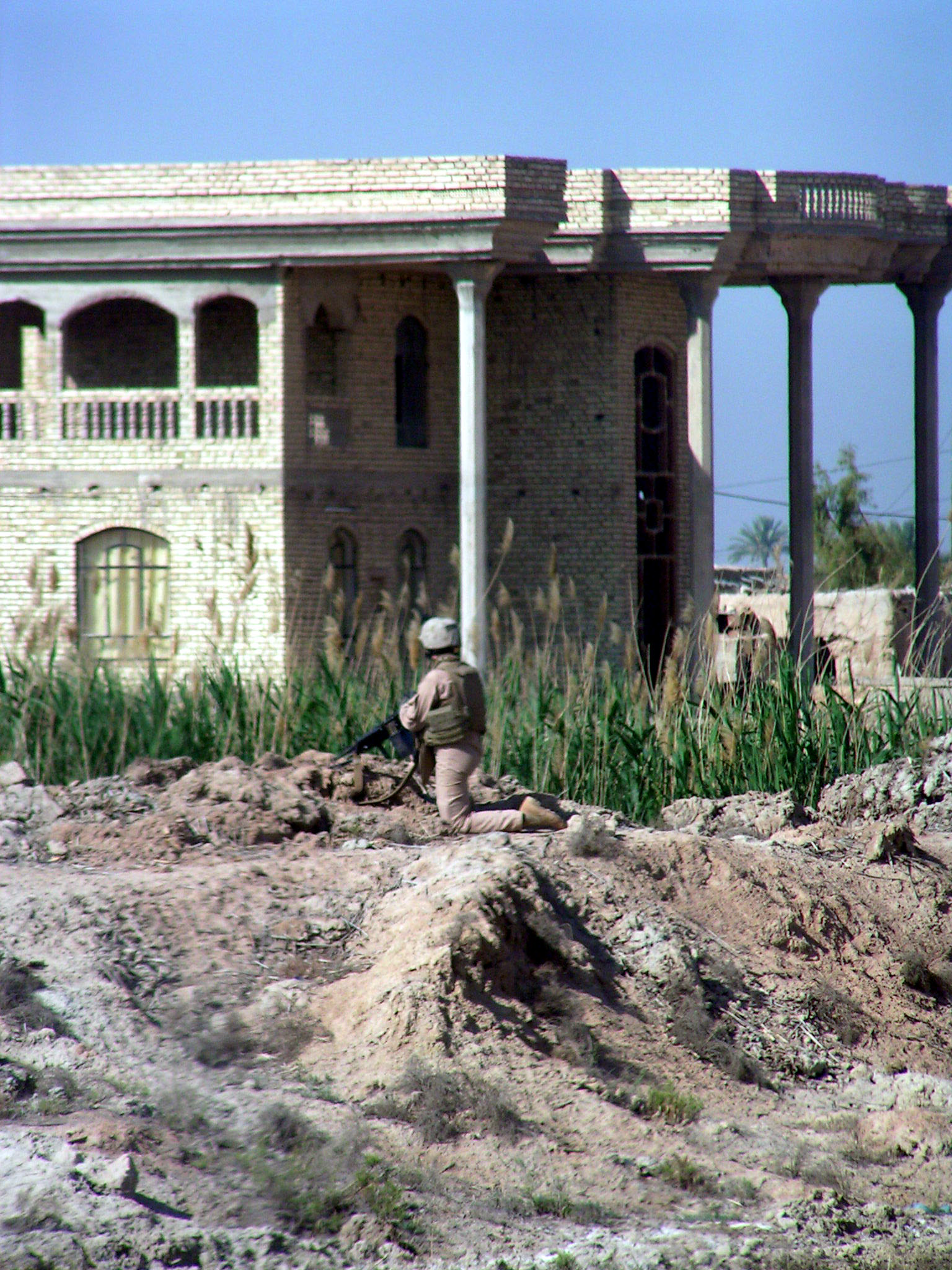
S&R 005Like a surreal scene from a Vietnam war movie, the Huey and Cobra gunship team banked hard in a continuous, close flight pattern, their rotors chopping the air sharply, low enough to part the tall grass alongside the canal and expose anyone with hostile intent. But this wasn’t Vietnam. This was a dusty road outside of Karmah, in Anbar Province, Iraq. The canal paralleled the road, and a U.S. military engineer’s bridge crossed it at this location to grant access to the other side. The canal at that spot presently held, and refused to release, the M1A1 Abrams tank that brought us there. The same tank that had slipped off the narrow bridge in the dark and was presently upside down in the water, holding four Marines in death’s grip. We wanted to free those Marines. We wanted them back, but the canal wouldn’t give them up. The steep, undercut banks prevented the behemoth from being pulled out with cables, two of which had already snapped like rubber bands on previous attempts. The call had already been made for a M88 heavy recovery vehicle to be brought up from Camp Taqaddum, the primary logistics hub for the region, but it was a couple of hours out and we’d already ran out of darkness. The Huey and the Cobra were called in for our protection after daylight caught up with us. Daylight made us easy targets. The grass alongside the canal provided good concealment for snipers, so the gunship team served as our guardian angels. The concussion of their rotor chop thumped in our chests, even under our heavy body armor. It was a comforting feeling.

The call had come into the CP in the depths of darkness, as it often did. In Iraq in 2006, most operations were still conducted at night. Daylight was dangerous. Snipers. So we worked at night a lot, because the grunts worked at night a lot. And that’s when they often died. That’s when we got the call.

We took duty in a 24 on/24 off rotation. During the day we busied ourselves with maintenance tasks. If it was night we slept on cots in the hut, at least until the land line rang. God how we dreaded that sound. That’s when we went to work. We never really slept on duty nights; we would lay down on a cot in our cammies with our boots next to us, body armor and weapons staged by the door, so that when the call came, we could be en route quickly. So the ring of that phone hung in our subconscious all the time, keeping true rest at bay and the ability to relax just beyond reach. When that happened, it meant Marines were dead, and their comrades were counting on us to come and take care of them. That was our job. To get them home again. Quickly. We were PRP.

PRP was the acronym for Personnel Retrieval and Processing, an occupational field known in wars past as mortuary affairs, and before that as graves registration. I suppose the the name change was reflective of how the task had progressed from one conflict to the next. When it was necessary for our war dead to be buried in the land where they fell, the graves were “registered” as a matter of record. As technology and transportation improved in subsequent wars, the mission became the expedited evacuation of our casualties so that they could be returned to their loved ones and buried in the United States. At some point around the time that the Marine Corps decided to assume this duty instead of relying upon the Army to provide the service, the powers-that-be decided that Personnel Retrieval and Processing had a more palatable connotation than mortuary affairs, and Marine Corps PRP was born. That’s where I slipped into the evolution. Our mission was to get our guys back on American soil within 48 hours. From a world away, the loved ones of our fallen would receive their remains a mere two days after life left their bodies, God willing and the flight ceiling was high enough. So when the call came, the clock started ticking. The pressure then was palpable.

Oddly enough, I volunteered for PRP due in large part to a misunderstanding. I had re-joined the Corps as a reservist in 2005, and I jumped at the first deployment opportunity that came down the line. The ALMAR (All Marine Message) that was disseminated throughout the Corps called for Marines from any occupational field to fill PRP billets, and it didn’t elaborate much beyond that. Upon initially seeing this message, my heart jumped. In the world of military acronyms that I was familiar with, PRP stood for Provisional Rifle Platoon- combat replacements. Casualties were still running high at this time, and I’d read articles about combat replacements being utilized. As a military policeman, I saw this as a way to finally serve as a rifleman with an infantry unit and prove to myself that I could live up to the words that Marines live by: “every Marine, regardless of rank or MOS, is first and foremost a rifleman.” So I signed up. Days later, once there was a little more clarification on what PRP actually stood for and what the mission was, everyone who signed up was given the opportunity to reconsider. However, most of us decided that while the job was not as glamorous as that of a rifleman, it was obviously a very important one. Ultimately we decided that the task was ours to do and elected to stay on the roster. No one left behind.

Waiting for the M88, the minutes ticked by, the sun and the temperature rose higher, and the tension at the scene increased. Junior Marines cursed and paced. Subordinate leaders attempted to keep things calm. Commanders conferenced and talked on the radios. No one liked waiting around like sitting ducks for enemy snipers or shoot-and-move mortar teams in raggedy pickup trucks. But no one was leaving without that tank and those Marines. The look on the faces of their buddies was heart wrenching. Their friends were merely feet away, concealed within the belly of the mostly submerged steel beast, but they couldn’t do anything to get them back. Finally the M88 arrived on the scene, but the banks of the canal were simply too steep to pull the tank out. The banks had to be cut away if any progress was to be made.

At about that same time, and much to our dismay, word came that the gunship team was low on fuel and couldn’t remain on station much longer. Another team would be en route to relieve them, or they would fly back to TQ to refuel and then return, but they would be delayed. Either way, we would soon be without overhead, and the tension ratcheted up a few more notches. On-scene commanders decided that it was time for bolder measures.

Across the canal, close to a date palm grove, a local farmer (insurgent?) worked on an irrigation ditch with a small excavator. If we had access to that excavator, the sharp banks of the canal could probably be rounded over enough to pull the tank out. Commanders, accompanied by a small security element and an interpreter, trekked across the field and approached the farmer while we watched from afar, nervous with anticipation of a firefight breaking out at any moment when enemy observers spotted the isolated group. But no shots rang out, no mortars fell, and no rockets screamed in. The commanders spent several minutes in conversation with the farmer, and after a short time returned to the canal. The farmer would not help us. He was afraid of insurgent retaliation if he provided assistance to the Americans. If this was the truth, and he himself was not actually a farmer-by-day-insurgent-by-night, I suppose no one could blame him. He had his family’s safety to consider, and there was certainly no way to conceal any help he provided.

When word of the farmer’s refusal spread, tempers flared and junior Marines went to work with the “fuck it, we’ll do it our damn selves” attitude that has probably gotten more done in the history of the Marine Corps than anything else. Within minutes, Marines with nothing more than a few shovels and entrenching tools went to work on the banks by hand- with a purpose and at a furious pace.

As the Marines doing the digging made some headway against the earth, our PRP team began preperations for the extraction of the four Marines’ bodies from the tank. Up until then, we’d merely been observers on the scene, but very soon we would be center stage and all of their buddies would be scrutinizing every move we made. This was always a delicate time in recovery operations. We always tried to be fairly detached and mechanical in our mission, out of a sense of psychological self-preservation as much as anything, but also because one false move or poorly chosen word might be interpreted by a fallen Marine’s buddies as inconsiderate or disrespectful and set them off. We could not afford that. We were still in hostile territory in broad daylight, and all of us had to focus on accomplishing our tasks and getting the hell out of there. So our team quietly planned out what our movements and actions would be as soon as the tank was extracted. While we did this, fellow Marines of the four trapped in the tank made it known that they would be the ones to go inside the beast to retrieve their friends. That threw a kink into our plan; typically, we strongly discouraged this because of the potential psychological impact it might have on combat troops. But it was clear that there would be no arguing the point with these Marines, and we weren’t about to make the mistake of acting like we were in charge of the scene.

At about that time, the recovery vehicle uprighted the tank and began to pull it from the water. The diesel power plant of the M88 roared as it put its back into the work. The M1A1 dug into the rounded corner of the canal and began to plow its way through. The massive steel cables stretched taught, prompting all of us to hide behind other vehicles, waiting for them to break with a deafening snap like the ones before. But this time the cables held. The tank pushed a mass of dirt before it as it cleared the bank, finally on dry ground. The recovery vehicle’s engine idled down in relief before the operator shut it off. Everyone on the scene breathed a heavy sigh.

We quickly staged the four litters and HRP’s (Human Remains Pouches, the politically correct term for body bags) by the side of the beast as Marines began the process of extraction. The first three were easy enough to remove. The fourth, the vehicle’s driver, posed a challenge because of his position deep within the tank. The most difficult part was that, due to the length of time that had passed, rigormortis had already set in. As the first of the fallen were brought through the hatch, the sight of stiffened, outstretched arms and a face frozen in death caused many of their buddies to turn away. Others stared on with indescribable looks on their faces. We waited at the base of the tank as their bodies were passed down to us. It was then up to us to encase the fallen in the HRP’s; not an easy task after rigor has taken hold. With their friends looking on, we placed them as carefully as we could on the opened bags and began the zipping process, pressing down hard on joints and straightening limbs as we went, just so the body would fit into the pouch and we could zip it up. There was simply no way to make it look good. Rigor is a tremendous force of nature, and to defeat it takes a lot of force. It was obvious to their buddies that it was a difficult task, and fortunately none of them took it as mishandling the remains of their friends.

At last, all four Marines were extracted, placed in HRP’s, and packaged on our vehicle, ready to begin their final journey home. A combination of relief and urgency then set upon the scene as the entire operation was wrapped up and we all prepared to get out of the area. All of us had been awake for a long time; we were tired, the whole thing had been somewhat surreal, and we wanted desperately to leave before anyone else died. Besides, we still had much work to do once safely back inside the wire. The families of four Marines were counting on us to get them home, although they probably didn’t even know it yet. The M1A1 was finally loaded onto a flat bed recovery truck, the order of march was set, and the convoy set out for Camp Fallujah.

It was almost midday in Karmah, Iraq. And I hated that damned place.

A Study in Contrast

Orange Beach

MINOLTA DIGITAL CAMERA

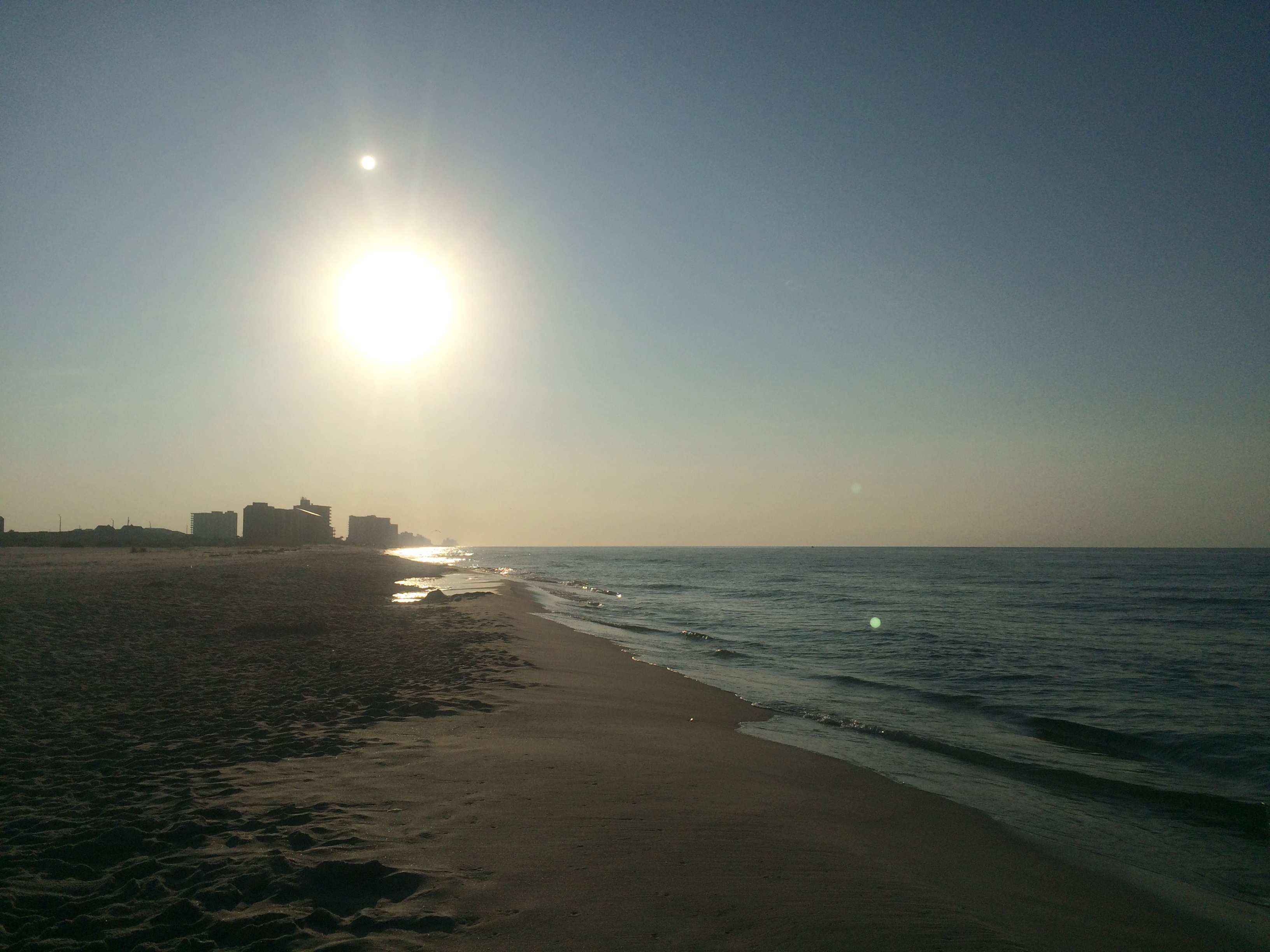
A few days ago I sat poolside at a family resort on the Gulf of Mexico, soaking up way too much sun and not a little alcohol. The ladies had ventured out to sort through the commercial flotsam of the local shopping district, and the rest of the guys had ventured onto the high seas in search of scaly quarry. I, having become very susceptible to motion sickness in recent years, opted for a day of poolside respite.

It occurred to me, as I stared from beneath my Oakleys and ball cap, that I’d not had such an opportunity in more years than I could recall. No immediate obligations. Just time to sit, observe, and think.

It had been nine years since I returned from Iraq. Another lifetime ago, it seemed. I’m a veteran now, not someone still in the mix. I don’t run around with “OIF veteran” and USMC stickers on my truck, and I don’t wear the tee shirts or the ball cap. I like being invisible. I don’t talk about it unless asked, but it doesn’t bother me or define who I am. It’s just something I did.

But every once in a while, in rare moments like the one by the pool, the sobering reality comes back. A reality like none other. The sickening boom of an IED in the distance, immediately followed by machine gun fire. Artillery firing overhead. The “crumpf” sound of incoming mortars. The endless drone of diesel generators. Dead Marines. Live Marines. Tears of those who loved them. Photos in their pockets. Names. Faces. Sounds and smells. My God, the smells.

I’m not a nosey person, but I found myself eavesdropping on a couple of young guys hitting on the cute girl a couple of chairs down from me. They were just starting college, and she was just finishing. They were all participating in the dance, but none would admit it. Then for some reason I got a little pissed off. It was amusing really, the falseness of it all. It was all such bullshit. Just a handful of years prior to that, my fellow Marines and I numbly and mechanically processed and prepared dead Marines about the same age as these knuckleheads for their final journey home. Kids who joined the Marine Corps, perhaps with visions of wartime grandeur or maybe a genuine sense of duty, but who all met the same end: going home beneath the colors of their country in a flag-draped transfer case, leaving behind heart-broken friends and family. For what? That shithole of a country that has since reverted back to the same shithole it always was and will be? And here these kids were, absolutely oblivious to the savage reality and brutal end that other Americans their age faced just a few years prior. Damn that made me mad.

But as I sat and listened to the silly, shallow banter being exchanged between these youngsters just entering adulthood, I quietly let those feelings process, brew, and then sterilize themselves. I realized that this is exactly the way it’s supposed to be. Young Americans go off to war to do our country’s bidding, for whatever stated reason, ultimately so that other young Americans can lounge in the beachfront pool and try to get a date with other young Americans, completely oblivious to how awful a large part of the rest of the world might be.

And I was finally okay with that. Because all of us who have done it, or will do it, sign up of our own volition. We may or may not fully understand the things that drive us to do so, or what the eventual rewards will be, if any. But we do it anyway. For those of us that live to tell the tale, we lounge by the Gulf of Mexico while we watch America happen right before our eyes, and we know that it was indeed worth it. And it always will be.

Veteran’s Day Speech, 2014

Author’s note: This was a speech that I delivered on Veterans’ Day, 2014 for a ceremony held at Lakewood Baptist Church in Gainesville, GA. If I’d known ahead of time how much emotional difficulty I would have in delivering it, I may have backed out of the whole thing. A flood of emotion came over me, most unexpectedly, and I had to pause more than once to get through it. It brought to my attention the possibility that I may have some unreconciled issues from my tour. I’m not broken, I sleep just fine, and I don’t need sympathy; it might just be something to address. Please forgive the broken format of the writing, I’ve published it here just like I wrote the speech notes.
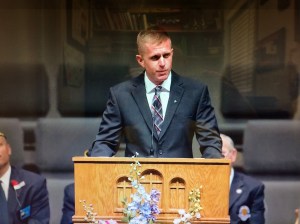
Veterans' Day 2014

___________________________

Good morning ladies and gentlemen, and thank you for the opportunity to speak here today.

Before I begin, I must confess that I’m here due in large part to the fact that I’m simply trying to be a good Marine.

A few months ago I was approached by a good friend of mine, LtCol Scott Ballard, USMC retired.

LtCol Ballard called me up and said he wanted to stop by my office for a friendly visit… he’s never done that before.

Now, I’ve been out of the Marine Corps for a few years, but I’ll confess that I experienced a little trepidation about the Colonel’s visit. Maybe it was just left over from the days of speaking only when spoken to by a field grade officer, I don’t know, but I was a little nervous.

So LtCol Ballard stopped in and we had a friendly chat and visited for 10 or 15 minutes before the other shoe- or combat boot, as it may be- dropped.

“Stephen,” he said, “I don’t know if you’d be interested or not, but as you know I spoke at last year’s Veteran’s Day event at Lakewood Baptist Church, and they’re wanting me to help identify someone to be this year’s speaker…”

That was the Colonel’s way of saying, “Tag- you’re it Marine!”

So like any good enlisted Marine, I said, “aye-aye sir” and marched with my orders. And here I am.

But I’m kidding, of course. I’m more than humbled and honored that the Colonel and the staff of the American Legion Post would consider me for the occasion, and I would like to thank them all for this opportunity.

In talking with the Colonel about speaking today, I explained how I wasn’t sure I’m the right person for the job. I have no grand combat exploits to tell. I didn’t suffer any tragic war wounds or have a chest full of medals for valor. I’m no hero… I’m just a regular Marine.

“Just tell a story,” he said.

So I gave that some thought, and I came to the conclusion that I’m not really comfortable telling my own lackluster story, when there are so many men and women out there that have truly extraordinary ones.

I guess I feel a little embarrassed to stand here today drawing attention to myself, because there truly are heroes among us, despite that term being somewhat over-used in recent years, and they are the ones deserving of the credit.

But back to my purpose today… “just tell a story,” the Colonel said.

So I thought about it, and the only way to say it is this: my story is not mine at all. It’s the story of veterans- all of us.

And after all that’s what today all about – Veteran’s Day.

Webster’s defines a veteran as “an old soldier of long service or a former member of the armed forces.”

While I don’t disagree with that definition, it’s a bit mechanical, and I say that because it leaves so many things unmentioned.

It does an adequate job of telling us what a veteran is… but it fails miserably in telling us who our veterans are.

So that’s what I’d like to do… talk about who our veterans are.

———————————————–

The definition doesn’t allude to the turmoil experienced by all Soldiers, Sailors, Airmen and Marines when they find themselves saddled with the task of informing their loved ones that they would soon be shipping out for war- either by choice or mandate.

For me, that was a night not unlike many others. It was 2005 and I had just recently re-joined the Marine Corps Reserve after being out for several years. My wife- who was very pregnant at the time with our second son- sat with me in our living room watching TV, after we’d put our three year-old son to bed.

My stomach was in a knot, but somehow I finally got up the gumption to tell her that her that a deployment opportunity was on the horizon and they were calling for volunteers.

I didn’t really know how to advance the conversation beyond that point, but she was obviously reading my mind.

“Are you thinking you want to go?” she asked.

My response was to say- almost apologetically- “I’d kinda like to.”

And with tears welling up in her eyes, knowing full well that I had a choice in the matter, my wife’s only reply was, “well I don’t guess you really have any choice, do you?”

How many times has that same scenario played out in living rooms across America?

Those men and women- the ones that have had to look their wives and husbands in the eye and say it’s time to go- they are your veterans.

———————————————–

But I should probably back up just a bit.

When I rejoined the reserve, I really did it with one intention- to deploy to either Iraq or Afghanistan at the earliest opportunity.

I didn’t have to wait long. The Marine Corps soon announced that it need volunteers for a deployment cycle, and it didn’t matter what your military occupational specialty was because they were filling billets for a unit called “PRP.”

Well, in the lingo that I knew, the acronym “PRP” stood for Provisional Rifle Platoon, otherwise known as combat replacements.

“This is it!” I thought. I’m going to get my chance at an assignment with an infantry unit and fulfill the age-old axiom that the Marine Corps lives by: “Every Marine is first and foremost a rifleman.”

Well… not exactly. In this instance, PRP was short for Personnel Retrieval and Processing- formerly known as mortuary affairs, or in wars past as graves registration. The primary mission of the unit is the timely and proper evacuation of our battlefield casualties back to the United States for burial.

I gave it some thought, and in the end I decided that as unpleasant a business as that may be, it was a very important one.

“No one left behind” is a common phrase in the military. It was time to put my money where my mouth was. So I signed up.

Which brings me back to that conversation with my wife that night.

A short time after that, I hugged and kissed my wife, my newborn son, and my 3 year-old before heading out the door with my sea bags packed.

And that scenario too, has been repeated all across the country, far too many times to count.

All the men and women who packed their gear and kissed their babies goodbye- some for the last time- they are your veterans.

———————————————–

Shortly after I arrived in Fallujah, we were sent out on our first recovery mission. A Humvee had been hit by an improvised explosive device. Several Marines had been wounded, and one had been killed.

Our team arrived at the attack site in the pre-dawn hours and we were met by a young, solemn-faced Staff Sergeant who explained the security situation, the attack, and then pointed us to the vehicle.

He left us to the grim task of recovering the fallen Marine from the vehicle, and once completed, prepared us all for extraction from the area. But before we all mounted up in our vehicles, he paused and thanked us.

The SSgt told us that the Marine that had been killed was only on the mission that night because he wanted to be. His unit’s tour was at its end, but he’d tagged along just to make sure- one last time- that the crew that was replacing him was locked-on. He didn’t even have to be there. Had he not gone, the SSgt I was speaking to would probably have been in that seat.

That sobering reality was visible all over the SSgt’s face.

How many of our servicemen and women have lived through it- right next to others that didn’t- and been tormented by the question, “Why them and not me?” Those men and women are your veterans.

———————————————–

One afternoon in Fallujah our team was at the command post with nothing much going on. In our business, boredom was a good thing.

We were situated right next door to the battalion surgical center, so you can probably imagine some of the activity that went on around there.

Suddenly we heard the sound of vehicles rapidly approaching, with horns blaring and someone shouting.

The vehicles roared up to surgical and a frenzy of Marines and Navy Corpsmen swarmed over one particular Humvee, off-loading casualties and rushing them inside.

One Marine- the one that we’d heard doing all the shouting- was obviously distraught.

He dismounted from the turret of his vehicle, slammed his helmet on the ground and turned loose a blistering string of profanity as he kicked the helmet and slung the rest of his gear onto the ground before collapsing to his knees and weeping uncontrollably.

A Navy Chaplain was soon at his side.

His buddy was one of those casualties and had been killed by a sniper.

That Marine, and countless others that lose their buddies in hostile foreign lands- they are your veterans.

———————————————–

As part of our job, we always dealt with a representative from the unit of a fallen Marine, usually the most senior enlisted men and officers. There were business matters that had to be tended to: positive identification, inventory of gear and personal affects, etc.

As a result, senior leadership visited us often, and they were familiar with our processes, procedures, and some of the challenges we faced.

One of those challenges was that we weren’t always able to get a fallen service member immediately en route for evacuation. Sometimes aircraft weren’t readily available, sometimes weather prohibited flight, sometimes hostile fire delayed them.

For any number of reasons, sometimes we just couldn’t start them on their final journey home right away, and our senior leaders understood this.

As such, a grim reality is that our unit had to maintain a walk-in refrigeration unit for such occasions. It was around in the back of our building, behind camouflage netting, out of sight from everyone. Those senior leaders knew about it though.

On more than one occasion, long after a casualty was brought in, processed, and awaiting a transport helicopter, we would get a knock on the door in the darkness.

We would open it to be greeted solemnly by one or two of those senior leaders, sometimes with a Navy Chaplain in tow, with a simple request: “can I step out back to spend a few minutes with my Marine?”

It was against our policy to do this once the refrigeration unit was closed, but I don’t have to tell you what our reply was. We violated that policy every single time.

I would unlock the unit and stand by, cover in hand and head bowed while those leaders attempted to make their peace with what had happened to one of those in their charge.

It wasn’t until I saw a Captain of Marines lift his head from prayer one night at the doorway of that refrigeration unit with tears in his eyes that I fully appreciated the burden of command.

That Captain, and all those that lead us into battle, willingly bearing that burden and living with the consequences- they are your veterans.

———————————————–

And while there are many more instances that I could relate that are no less poignant than these, I’ll relate just one more.

While serving at AL Taqaddum we received word that a unit was bringing in a casualty, but this one was going to be handled a little bit differently. Members of his unit would be present while we conducted our business, which was expressly forbidden under normal circumstances.

Prior to their arrival we learned that the casualty was the first Navy SEAL to be killed in Iraq, and his teammates were accompanying him all the way home.

There was much trepidation prior to their arrival, but once they were at our facility it became clear that these men were in fact the consummate professionals that they were reputed to be.

What we saw was not a down-trodden crew, hanging their heads and moping about in sorrow.

They were solemn, yes. But there was an indescribable air about them. They had a grim task at hand, and they were mourning their friend and comrade, but it was very clear that this too would pass.

And when it did, they would be right back in the fray, doing what they train to do.

Absolute professionals.

And that is the final point that I’ll leave you with- the men and women who we task with our nation’s most daunting tasks, the most dangerous missions in the most hostile lands, to go abroad and do our country’s bidding despite all the sacrifices and personal loss- those are your veterans.

———————————————–

In closing ladies and gentlemen, I would like to simply say thank you.

I thank those of you who have served… for your service.

I thank those of you who have loved and supported those who have served.

And I thank this great nation of ours for the opportunity to serve. For that I owe a debt of gratitude.

May God bless our veterans, and may God bless the United States of America.

Memorial Day in Iraq

Author’s note: Another piece from my blog during Operation Iraqi Freedom. It struck me at the time that I was spending Memorial Day living and seeing exactly what that day is all about in our country, and probably changed forever the seriousness and reverence with which I observe the holiday.

Sunrise, somewhere along MSR Michigan, Anbar Province, Iraq.

______________________________

Somewhere in America, a family sleeps late in comfortable beds in their air-conditioned home, because it’s a national holiday and there is no school or work.

Somewhere in Iraq, a Marine rises before dawn after sleeping for a few hours on a hard, concrete floor or on the dusty ground. He doesn’t even know it’s a holiday as he preps himself and his gear for another day in a hostile land.

The family sits at their kitchen table and has a late breakfast of eggs, omelets, or pancakes, with fresh milk and coffee while they leaf through the newspaper and talk about what they’ll do for the day.

The Marine sits cross-legged on the ground, cuts open his MRE with his knife, and eats it cold. It’s not even a breakfast meal, and he washes it down with the first swallows of what will turn out to be gallons of water that he’ll drink during the course of the day. He’ll chat with another Marine or two about the day’s operation.

The family will take leisurely showers under steaming hot water, with soap and shampoo. They’ll dry off using fresh, plush towels and put on comfortable slippers.

The Marine might get a chance to take a field bath using baby-wipes. He’ll knock the edge off of the whiskers protruding from his face with something resembling a razor. There will be a vain attempt to mask his prominent odor with deodorant and perhaps a fresh t-shirt, but he hasn’t had fresh cammies to put on in a week, making it all an effort in futility. He puts on the same boots he’s worn for months, the ones that have caused his feet to be covered in calluses.

The family is off to the lake for the day. They’ve loaded their boat with coolers, picnic supplies, water skis and fishing poles.

The Marine is off on yet another patrol. He’s loaded his Humvee with water, medical supplies, a heavy machine gun, and extra ammunition.

The family cruises across the glistening water, bouncing on the boat wakes and waving to the other boaters.

The Marine rides along dry, dusty roads behind bulletproof glass and armor. Lots of people watch him pass. Nobody waves.

The family stops at lunchtime on an island in the lake. Pulling up to the beach, they unload their supplies and set out a comfortable spread. The children run about and explore the area.

The Marine stops about lunchtime, too. But his purpose is to set up a vehicle checkpoint to search for insurgents transporting bomb-making material. He unloads concertina wire, signs, and temporary barriers. He doesn’t eat lunch. No one ventures far from the vehicles.

On the lake, the family enjoys the sunshine wearing their swimsuits and flip-flops. They slather themselves in suntan oil to develop a nice, golden tan.

Out on the patrol, the Marine detests the sun because the temperature is already well over 100 degrees. He labors under the weight of his protective gear and sweats clear through his cammies. He smears the strongest sunblock he can find on what little skin is exposed because it’s been red with sunburn for days on end.

In the afternoon, the family heads back to the shore and loads up for the trip home. The kids fall asleep in the back seat during the ride, and the local radio station plays the latest hits.

After wrapping up the checkpoint, the Marine mounts back up and moves out toward their final destination for the day. Everyone is tired, but they struggle to stay awake and stay alert. The only radio they have is the one that links them with the rest of the patrol and the command post.

On their drive home, the family hits a pothole in the roadway and complains about what a lousy job of road maintenance the county is doing.

On his drive back to the operating base, the Marine is hit by an IED.

At the end of the day, the family arrives back home a little tired, but safe and sound, and happy to have spent the day together.

In Iraq, the Marine is mourned by his comrades and commanders. He’s laid in a flag-draped casket for the journey home.

In America, as the family settles in for the evening, there is a knock at the door. Standing at the threshold are two solemn faced Marines in dress blues…

Semper Fi, Fair Winds & Following Seas

Author’s note: This was the closing entry for my blog during the time I was in Iraq (2006). I’d grown to dread writing anything at all by this time, so I’ll let it speak for itself.

MSR Mobile sunrise

________________________

As my first, but perhaps not my last, tour in Iraq is drawing to a close, I’ve decided that in the next few weeks or so, I’ll shut down this blog. There is really only one good explanation, and it’s something that’s been troubling me for some time.

I’ve had difficulty overcoming the feeling that posting anything on the internet about myself during this tour has come across as self-serving BS. I can’t really post much about my day-to-day job, as it involves the deaths of servicemen, and to use their sacrifice as fodder for my self-indulgent purposes would be the height of disrespect.

I’m no hero. I don’t have any grand tales of combat exploits to share with the world. I’m just an average Marine that happened to volunteer for a job that brings the reality of war home to a multitude of families across America. Every time I do my job, one of those families is only minutes or hours away from receiving that dreaded knock on the door. There’s nothing glamorous about that.

I suppose it all came home for me once and for all when U.S. Navy SEAL Marc Lee was brought to our facility by his fellow SEALs, who were escorting him on his final journey home. You can read more about him here, at Blackfive. War for those guys, and those like them, is not what’s written on the internet. It’s heat, sweat, exhaustion, gunshots, explosions, flesh, blood, life, and finally death. I couldn’t look them in the eye, knowing that my war and my sacrifices are something so much less. The credit lies with those men. As Teddy Roosevelt said in his famous speech, “The Man in the Arena,”

“It is not the critic who counts: not the man who points out how the strong man stumbles or where the doer of deeds could have done better. The credit belongs to the man who is actually in the arena, whose face is marred by dust and sweat and blood, who strives valiantly, who errs and comes up short again and again, because there is no effort without error or shortcoming, but who knows the great enthusiasms, the great devotions, who spends himself for a worthy cause; who, at the best, knows, in the end, the triumph of high achievement, and who, at the worst, if he fails, at least he fails while daring greatly, so that his place shall never be with those cold and timid souls who knew neither victory nor defeat.”

And so, the time is past due that I should bow out, and leave the credit to those who rightfully deserve it.

To all of the warriors, I wish you Fair Winds & Following Seas.

Semper Fidelis

Green… again

Author’s Note: This piece was originally written in 2005 for Red State Rant, an online mostly political blog that my friend Lance McMurray was running at the time. He would occasionally allow me to post something non-political, I think to break up the monotony more than anything else. It was quickly picked up by Matthew Currier Burden and published on his very popular military blog, BlackFive. The following year he published it in his book, The Blog of War, a collection of blog entries by various authors.

Swearing in_____________________________

At Lance’s request, I’m proud to announce on Red State Rant that after an extended effort, I’ve finally been accepted back into Uncle Sam’s Big Green Gun Club. A little background:

My efforts began on September 11, 2001, when the news about the terrorist attacks in New York City came over the radio. I immediately drove to the recruiter’s office to inquire about reenlistment options. My advance was rebuked, however, due to an ankle injury that I’d sustained two months previous, one which eventually landed me on the surgeon’s slab six months later. Running, and therefore staying in shape, was a painful proposition for nearly a year thereafter. Then my wife and I decided to start our family, a decision that I in no way second-guess, but one which further altered my plans.

As I watched the kick-off of Operations Enduring Freedom and Iraqi Freedom from the sidelines, I couldn’t stand the fact that Marines were out there doing what Marines do, and here I was, a man of eligible age, riding the bench. The final straw came on the day that my brother, a career Marine until a back injury put him out of active duty after 15 years, emailed me a photo of himself being sworn back into the Corps as a reservist. That was simply more than I could stand.

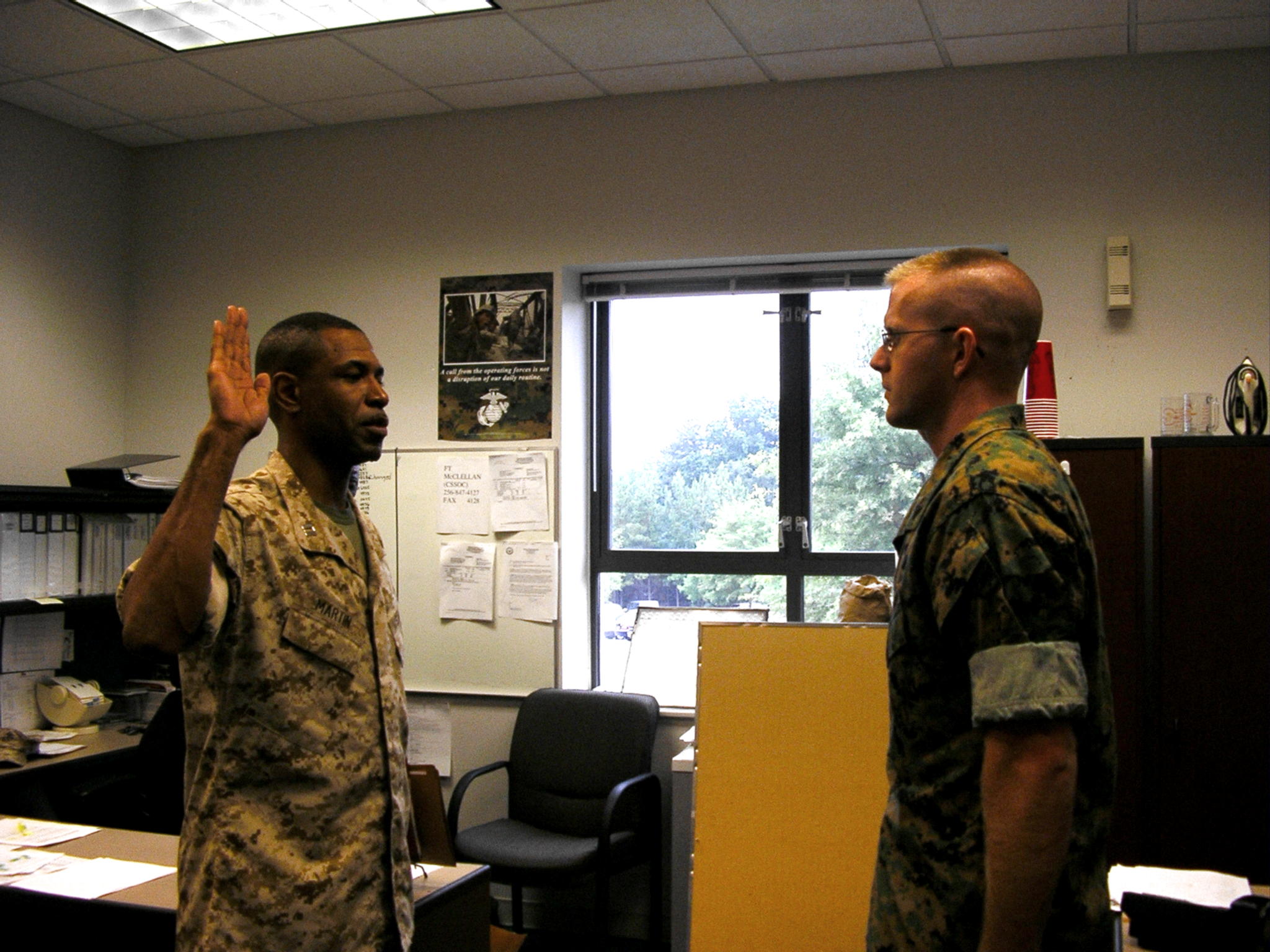
I got off my ass, got back in shape, and got on the phone with the prior service recruiter. Skipping all the sordid details of a paperwork nightmare, a little more than a year later, on July 10, 2005, I stood before a Captain with the 4th FSSG, raised my right hand, and took the oath of enlistment for the second time in my life, sworn-in as a 35 year-old Corporal of Marines (reserve) as my wife and son looked on.

I’d been off of active duty for almost 10 years, but as we walked out of the HQ building at the Navy/Marine Corps Reserve Center and passed a Colonel, the salute that I snapped felt just as natural as it ever had, and the uniform I wore felt like an old friend. I straightened my back, poked out my chest just a little, and stepped more smartly. God, it felt great to be green again!

I give the reader all of that to answer a question many people have asked, including Red State Rant blogmaster and my life-long friend, Lance: Why? After all, I’ve already served my country, “paid my dues,” or “done my time,” as some say.

To that, I have this to say: Serving my country is not a 4 year contract. It is a life-long commitment. Nor is it a “due” to be paid like some cheap membership fee. It is a deeply personal obligation. And it is certainly not “time” that has to be “done” like some felony prison sentence. It is nothing short of an honor that I hold in the highest regard, an honor that I must prove worthy of, an honor that must be earned every single day.

Many people have shaken their heads in disbelief, sometimes I think in disdain, when they learned of my plans. I’m a family man now, after all. Why would I volunteer, when there is a very real possibility of a combat deployment? Don’t I care about my family?

Without question, my family is the single most important part of my life on earth. But just exactly what sort of husband and father do I want for my family? What kind of man do I want my wife to devote her life to? When my children are grown, what is the picture of their father going to look like in their minds? I’ll tell you: I want my beloved wife, to whom I am utterly devoted, to go through her days without a shadow of a doubt that the man she married is a man of honor and commitment, a man that knows there are things in life worth giving one’s own life for, if necessary. I want her, as she looks out upon all of the world’s deception, falseness, infidelity, and evil, to know that her husband is on the right side of things.

I want my children to have a father that they can unwaveringly look up to as an example. I want them to grow up, not with an attitude of entitlement, but with a sense of duty, obligation, and reward. I want to teach them that we don’t always say, “Let the other guy do it.” Instead, I want them to learn that there are times that we must ask, “If not me, then who?” I want to be the best father I can be, and I can think of no better lessons to teach them than the value of honor, integrity, dedication, perseverance, and selflessness. I can offer no better example for my family than to strive to live those values every day in my own personal life.

All of that is a way of life for United States Marines.

In addition to all of that, throw in any applicable clichés regarding patriotism, fighting for our country, etc. They’re all no less true for me than anyone else who has said them, but they have become overused to the point that they have begun to lose effect. I will add one: revenge. I make no apology for wanting to kill the bastards that want to kill us.

I harbor no illusions about saving the world, being a hero, or altering the course of events. It’s simply that at no time in my life have I been more proud and satisfied with what I was doing than while serving as an active duty Marine. My decision to leave the Corps, if I had it to do over, likely would have been different. I want to at least partially amend that decision while I am still young enough (barely) to do so. I love being around fellow Marines, doing what Marines do: training, fighting, working, sweating, cussing, bitching, adapting, improvising, overcoming, accomplishing the mission, and taking care of each other.

Lastly, these are historic times for our country and for my Marine Corps. For me, it’s decision time- sit on the sidelines and merely be an observer, or step up and be a participant.

I’m stepping up.

Semper Fidelis