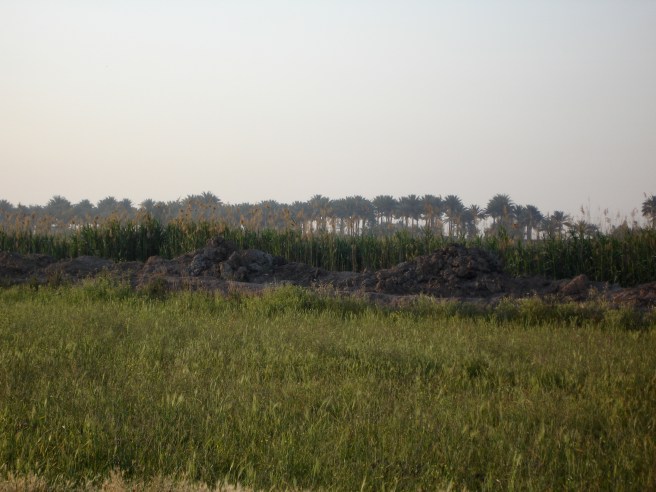
 Like a surreal scene from a Vietnam war movie, the Huey and Cobra gunship team banked hard in a continuous, close flight pattern, their rotors chopping the air sharply, low enough to part the tall grass alongside the canal and expose anyone with hostile intent. But this wasn’t Vietnam. This was a dusty road outside of Karmah, in Anbar Province, Iraq. The canal paralleled the road, and a U.S. military engineer’s bridge crossed it at this location to grant access to the other side. The canal at that spot presently held, and refused to release, the M1A1 Abrams tank that brought us there. The same tank that had slipped off the narrow bridge in the dark and was presently upside down in the water, holding four Marines in death’s grip. We wanted to free those Marines. We wanted them back, but the canal wouldn’t give them up. The steep, undercut banks prevented the behemoth from being pulled out with cables, two of which had already snapped like rubber bands on previous attempts. The call had already been made for a M88 heavy recovery vehicle to be brought up from Camp Taqaddum, the primary logistics hub for the region, but it was a couple of hours out and we’d already ran out of darkness. The Huey and the Cobra were called in for our protection after daylight caught up with us. Daylight made us easy targets. The grass alongside the canal provided good concealment for snipers, so the gunship team served as our guardian angels. The concussion of their rotor chop thumped in our chests, even under our heavy body armor. It was a comforting feeling.
The call had come into the CP in the depths of darkness, as it often did. In Iraq in 2006, most operations were still conducted at night. Daylight was dangerous. Snipers. So we worked at night a lot, because the grunts worked at night a lot. And that’s when they often died. That’s when we got the call.
We took duty in a 24 on/24 off rotation. During the day we busied ourselves with maintenance tasks. If it was night we slept on cots in the hut, at least until the land line rang. God how we dreaded that sound. That’s when we went to work. We never really slept on duty nights; we would lay down on a cot in our cammies with our boots next to us, body armor and weapons staged by the door, so that when the call came, we could be en route quickly. So the ring of that phone hung in our subconscious all the time, keeping true rest at bay and the ability to relax just beyond reach. When that happened, it meant Marines were dead, and their comrades were counting on us to come and take care of them. That was our job. To get them home again. Quickly. We were PRP.
PRP was the acronym for Personnel Retrieval and Processing, an occupational field known in wars past as mortuary affairs, and before that as graves registration. I suppose the the name change was reflective of how the task had progressed from one conflict to the next. When it was necessary for our war dead to be buried in the land where they fell, the graves were “registered” as a matter of record. As technology and transportation improved in subsequent wars, the mission became the expedited evacuation of our casualties so that they could be returned to their loved ones and buried in the United States. At some point around the time that the Marine Corps decided to assume this duty instead of relying upon the Army to provide the service, the powers-that-be decided that Personnel Retrieval and Processing had a more palatable connotation than mortuary affairs, and Marine Corps PRP was born. That’s where I slipped into the evolution. Our mission was to get our guys back on American soil within 48 hours. From a world away, the loved ones of our fallen would receive their remains a mere two days after life left their bodies, God willing and the flight ceiling was high enough. So when the call came, the clock started ticking. The pressure then was palpable.
Oddly enough, I volunteered for PRP due in large part to a misunderstanding. I had re-joined the Corps as a reservist in 2005, and I jumped at the first deployment opportunity that came down the line. The ALMAR (All Marine Message) that was disseminated throughout the Corps called for Marines from any occupational field to fill PRP billets, and it didn’t elaborate much beyond that. Upon initially seeing this message, my heart jumped. In the world of military acronyms that I was familiar with, PRP stood for Provisional Rifle Platoon- combat replacements. Casualties were still running high at this time, and I’d read articles about combat replacements being utilized. As a military policeman, I saw this as a way to finally serve as a rifleman with an infantry unit and prove to myself that I could live up to the words that Marines live by: “every Marine, regardless of rank or MOS, is first and foremost a rifleman.” So I signed up. Days later, once there was a little more clarification on what PRP actually stood for and what the mission was, everyone who signed up was given the opportunity to reconsider. However, most of us decided that while the job was not as glamorous as that of a rifleman, it was obviously a very important one. Ultimately we decided that the task was ours to do and elected to stay on the roster. No one left behind.
Waiting for the M88, the minutes ticked by, the sun and the temperature rose higher, and the tension at the scene increased. Junior Marines cursed and paced. Subordinate leaders attempted to keep things calm. Commanders conferenced and talked on the radios. No one liked waiting around like sitting ducks for enemy snipers or shoot-and-move mortar teams in raggedy pickup trucks. But no one was leaving without that tank and those Marines. The look on the faces of their buddies was heart wrenching. Their friends were merely feet away, concealed within the belly of the mostly submerged steel beast, but they couldn’t do anything to get them back. Finally the M88 arrived on the scene, but the banks of the canal were simply too steep to pull the tank out. The banks had to be cut away if any progress was to be made.
At about that same time, and much to our dismay, word came that the gunship team was low on fuel and couldn’t remain on station much longer. Another team would be en route to relieve them, or they would fly back to TQ to refuel and then return, but they would be delayed. Either way, we would soon be without overhead, and the tension ratcheted up a few more notches. On-scene commanders decided that it was time for bolder measures.
Across the canal, close to a date palm grove, a local farmer (insurgent?) worked on an irrigation ditch with a small excavator. If we had access to that excavator, the sharp banks of the canal could probably be rounded over enough to pull the tank out. Commanders, accompanied by a small security element and an interpreter, trekked across the field and approached the farmer while we watched from afar, nervous with anticipation of a firefight breaking out at any moment when enemy observers spotted the isolated group. But no shots rang out, no mortars fell, and no rockets screamed in. The commanders spent several minutes in conversation with the farmer, and after a short time returned to the canal. The farmer would not help us. He was afraid of insurgent retaliation if he provided assistance to the Americans. If this was the truth, and he himself was not actually a farmer-by-day-insurgent-by-night, I suppose no one could blame him. He had his family’s safety to consider, and there was certainly no way to conceal any help he provided.
When word of the farmer’s refusal spread, tempers flared and junior Marines went to work with the “fuck it, we’ll do it our damn selves” attitude that has probably gotten more done in the history of the Marine Corps than anything else. Within minutes, Marines with nothing more than a few shovels and entrenching tools went to work on the banks by hand- with a purpose and at a furious pace.
As the Marines doing the digging made some headway against the earth, our PRP team began preperations for the extraction of the four Marines’ bodies from the tank. Up until then, we’d merely been observers on the scene, but very soon we would be center stage and all of their buddies would be scrutinizing every move we made. This was always a delicate time in recovery operations. We always tried to be fairly detached and mechanical in our mission, out of a sense of psychological self-preservation as much as anything, but also because one false move or poorly chosen word might be interpreted by a fallen Marine’s buddies as inconsiderate or disrespectful and set them off. We could not afford that. We were still in hostile territory in broad daylight, and all of us had to focus on accomplishing our tasks and getting the hell out of there. So our team quietly planned out what our movements and actions would be as soon as the tank was extracted. While we did this, fellow Marines of the four trapped in the tank made it known that they would be the ones to go inside the beast to retrieve their friends. That threw a kink into our plan; typically, we strongly discouraged this because of the potential psychological impact it might have on combat troops. But it was clear that there would be no arguing the point with these Marines, and we weren’t about to make the mistake of acting like we were in charge of the scene.
At about that time, the recovery vehicle uprighted the tank and began to pull it from the water. The diesel power plant of the M88 roared as it put its back into the work. The M1A1 dug into the rounded corner of the canal and began to plow its way through. The massive steel cables stretched taught, prompting all of us to hide behind other vehicles, waiting for them to break with a deafening snap like the ones before. But this time the cables held. The tank pushed a mass of dirt before it as it cleared the bank, finally on dry ground. The recovery vehicle’s engine idled down in relief before the operator shut it off. Everyone on the scene breathed a heavy sigh.
We quickly staged the four litters and HRP’s (Human Remains Pouches, the politically correct term for body bags) by the side of the beast as Marines began the process of extraction. The first three were easy enough to remove. The fourth, the vehicle’s driver, posed a challenge because of his position deep within the tank. The most difficult part was that, due to the length of time that had passed, rigormortis had already set in. As the first of the fallen were brought through the hatch, the sight of stiffened, outstretched arms and a face frozen in death caused many of their buddies to turn away. Others stared on with indescribable looks on their faces. We waited at the base of the tank as their bodies were passed down to us. It was then up to us to encase the fallen in the HRP’s; not an easy task after rigor has taken hold. With their friends looking on, we placed them as carefully as we could on the opened bags and began the zipping process, pressing down hard on joints and straightening limbs as we went, just so the body would fit into the pouch and we could zip it up. There was simply no way to make it look good. Rigor is a tremendous force of nature, and to defeat it takes a lot of force. It was obvious to their buddies that it was a difficult task, and fortunately none of them took it as mishandling the remains of their friends.
At last, all four Marines were extracted, placed in HRP’s, and packaged on our vehicle, ready to begin their final journey home. A combination of relief and urgency then set upon the scene as the entire operation was wrapped up and we all prepared to get out of the area. All of us had been awake for a long time; we were tired, the whole thing had been somewhat surreal, and we wanted desperately to leave before anyone else died. Besides, we still had much work to do once safely back inside the wire. The families of four Marines were counting on us to get them home, although they probably didn’t even know it yet. The M1A1 was finally loaded onto a flat bed recovery truck, the order of march was set, and the convoy set out for Camp Fallujah.
It was almost midday in Karmah, Iraq. And I hated that damned place.

 Infrequently Sublime